We use cookies to ensure you get the best user experience on our website.Find Out More
Mobile apps, web apps, any platform. One shake, click, or tap gets you video reproductions, network logs, and everything developers need to fix issues fast.
Installation
Bugs
Crashes
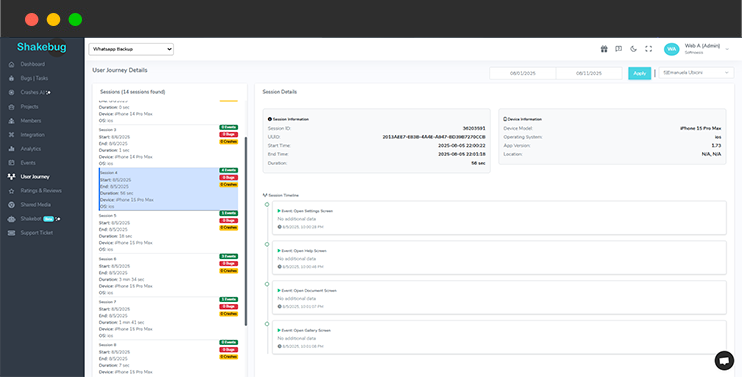
Sessions


































With Shakebug, you see bugs and the complete narrative. Get a clear timeline with our user journey, connecting sessions, events, bug reports, and crash data. See navigation, actions, and exact issue points. Fix issues faster and prioritize work with accurate, actionable insights in the same reporting and monitoring tool.
Wave goodbye to the hassle of sorting through countless identical crash reports. With Crash AI, our platform smartly organizes recurring crashes, presenting just one entry that includes all the essential details like the first occurrence, affected devices, OS versions, and much more.


Along with bugs and crash reporting, Shakebug analyzes the application usage in different ways like session, language, countries etc. It also allows users to check analytics in the form of graphical representation over the selection period of time.
Developers/Users can add custom events and values for each action of the application easily where they want. In addition to this, users can also check the session of each event and value in graphical form as well.
Over 0 events tracked in action.

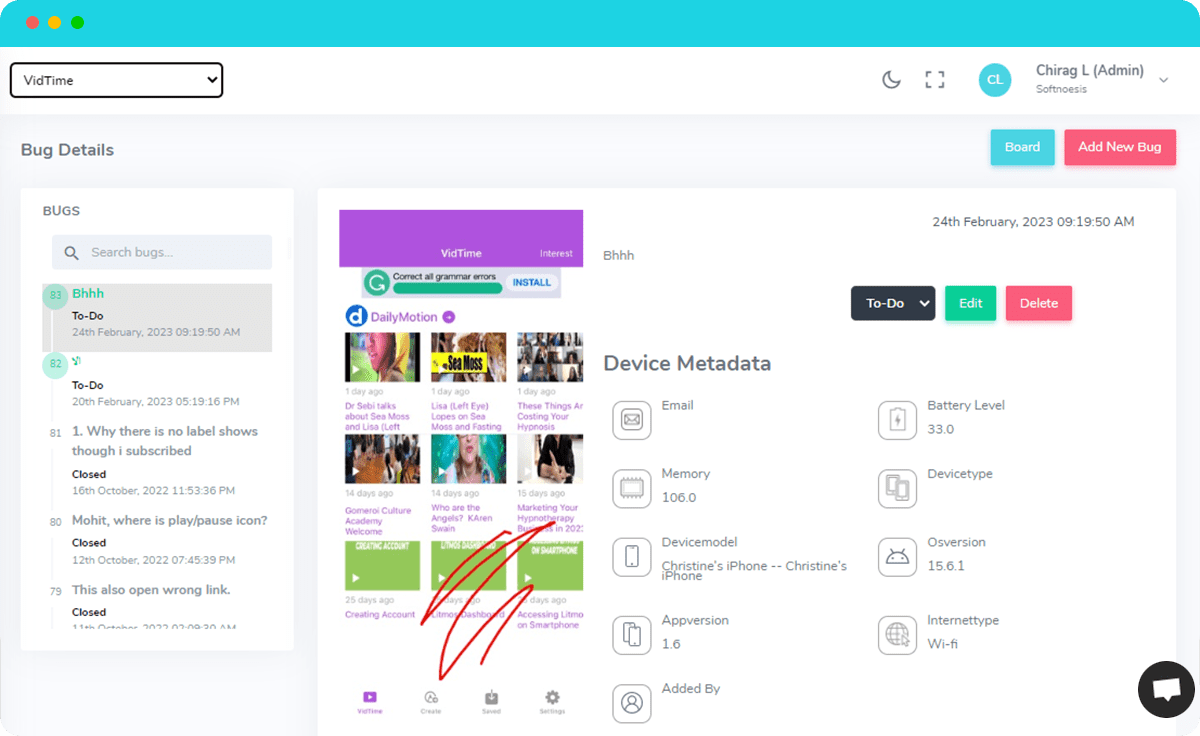
Shakebug helps users to highlight bugs by capturing the screenshot of the screen within a few clicks. This tool minimizes the bug reporting time for your tester and clients.
Shakebug will automatically report the crashes of applications whenever it occurs. Here users don't need to spend time for crash reporting.
Manmohan followed, all swagger and sequins, and performed with the unmistakable bravado of a man who believed his own legend. He danced with such gusto that a bucket of water, precariously placed behind him for reasons known only to improvisation, toppled and drenched the front row. Laughter erupted, forgiving and loud—the kind of laughter that tacks people together.
Act One: The Plan
The society courtyard was transformed: strings of colored bulbs crisscrossed overhead, folding chairs arranged in uneven rows, a makeshift stage built from planks and bound courage. The air thrummed with expectant murmurs and the smell of pakoras.
The morning sun spilled over Gokuldham Society like a warm secret. Birds argued in crisp chirps; a chaiwala tuned the samosa cart’s rickety bell; and the lane hummed with the polite chaos of neighbors claiming small territories of gossip, pride, and borrowed ladders. Bhabi Ji Ghar Par Hain Episode 1
Vibhuti took the stage first—nervous, earnest, and painfully sincere. His voice wavered; his lyrics trembled; but there was an honesty that carved through the hum of the crowd. He lost a couplet mid-line, then found it again. Somewhere in the audience, Angoori’s smile became a lighthouse; Manmohan’s jaw tightened as if he were measuring each note for its threat level.
That morning, the society’s notification board bore a slip of paper: “Cultural Program — Talent Show this Saturday.” A new stage, a new arena. For some, an opportunity to display skill; for others, a perilous chance to display self. Vibhuti’s eyes narrowed with the glint of a plan. Manmohan’s chest puffed with unearned confidence. Angoori simply smiled, as if she already knew how the scene would unfold and enjoyed each crease in the coming plot.
Rehearsals began in alleys and living rooms. Vibhuti’s ghazal trembled with sincerity but broke under the weight of forgotten words. Manmohan pirouetted into a stack of newspapers, earning a round of muffled laughter and a bruise shaped like irony. Anita, pragmatic as ever, tried to mediate costumes and stage props; she suggested sensible shoes for Manmohan and a cue-card for Vibhuti. The idea of a cue-card was met with moral outrage and then a quieter acceptance. Manmohan followed, all swagger and sequins, and performed
Angoori, who had heard more than she let on, exchanged a conspiratorial glance with her husband. But instead of fueling rivalry, she stepped aside into a quieter sort of mischief: she would perform a simple piece—an ode to the home. Not to provoke, but to remind everyone what mattered beyond applause. Her voice would be soft, but the occasion would render it loud.
The show closed in a mingled mess of triumphs and humility. Vibhuti, treated with indulgent applause, felt a quiet victory that had nothing to do with wooing. Manmohan, despite his theatrics, discovered the limit of spectacle when it drowns sincerity. Angoori returned to her flowers, furtive and content.
Across the narrow courtyard, the Mishras’ perennial rival and neighbor, Angoori Bhabhi, arranged flowers at her doorstep, folding her dupatta like a ceremonial flag. Her eyes sparkled with an innocent mischief that belied a sharper mind than most gave her credit for. She hummed a tune so sweet it was almost an apology to the world for the mischief she never quite intended. Act One: The Plan The society courtyard was
—End of Episode 1 —
When Angoori sang, the evening bent toward something gentler. Her voice was not the most trained, but it carried a warmth that settled into the audience like a shared blanket. Hands that had been clapping in amusement fell into thoughtful silence. Her ode to home didn’t humiliate or conquer; it reminded. The applause at the end was not just for performance but for memory.
Into this compact world stepped Anita, the new domestic help at the Tiwari residence—an efficient woman with practical solutions and an indifferent smile. She carried a box of cutlery and a secret: news from the Tiwari household that would act like a match in dry grass. Pradeep, the ever-oblivious husband, talked loudly about his uncle’s return from Kanpur and a promised antique radio that would make the house the envy of any neighborhood gathering.
At the center of their orbit lived the flamboyant Manmohan Tiwari, whose laugh arrived before he did and whose hair had ambitions. He polished a brass plate until the sun itself seemed jealous. Manmohan bore his tastes like a banner: flashy vests, louder jokes, and a heart that patrolled the border between charm and catastrophe. He fancied himself a connoisseur of courtship and a strategist of romance—especially when the target wore a saree, rattled a pallu, or smiled.
Vibhuti Narayan Mishra stood on his building’s balcony, buttoning his shabby kurta with exaggerated care. His spectacles sat askew, optimism glued to his face. He was a man whose moral compass pointed stubbornly toward propriety and whose imagination pointed—much more dangerously—toward the entrances of other people’s homes.

Open your application on your mobile phone and shake it. After that screen will appear where you can highlight the area of the bug.

After highlighting the area, a screen will appear where the user can write a bug description which explains the details about bugs or issues.
Once you report the bug, you will get the following screen with bug’s details along with device and OS information to your assigned developers. They can update its status when it is resolved.