
Multi-currency*
You can watch and trade several currency pairs at the same time.
All charts are synchronized and updated tick-by-tick.
* Available only in MT5 version of the simulator


Forex Simulator works as a plugin to Metatrader. It combines great charting capabilities of MT4 and MT5 with quality tick data and economic calendar to create a powerful trading simulator.
Use charts, templates and drawing tools available in Metatrader.
Forex Simulator lets you move back in time and replay the market starting from any selected day.
You can watch charts, indicators and economic news as if it was happening live...
...but you can also:
Everything works just like in real life, but there is no risk at all!
Watch your profit/loss, equity, drawdown and lots of other numbers and statistics in real time.
You can also export trading results to Excel or create a HTML report.
You can analyze your trading results to find weak points of your strategy.
Trading historical data saves a lot of time compared to demo trading and other forms of paper trading.
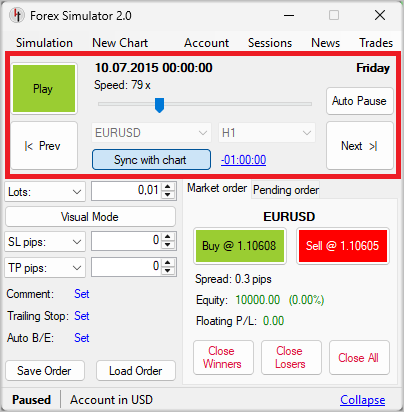
It also allows you to adjust the speed of simulation, so you can skip less important periods of time and focus on more important ones.
You can watch and trade several currency pairs at the same time.
All charts are synchronized and updated tick-by-tick.
* Available only in MT5 version of the simulator
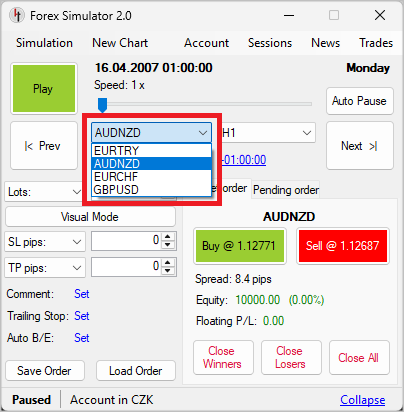
On Metatrader 5:
On Metatrader 4:
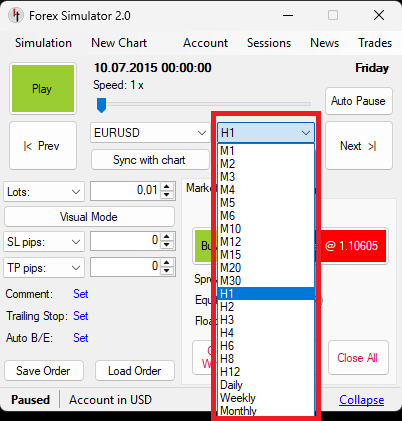
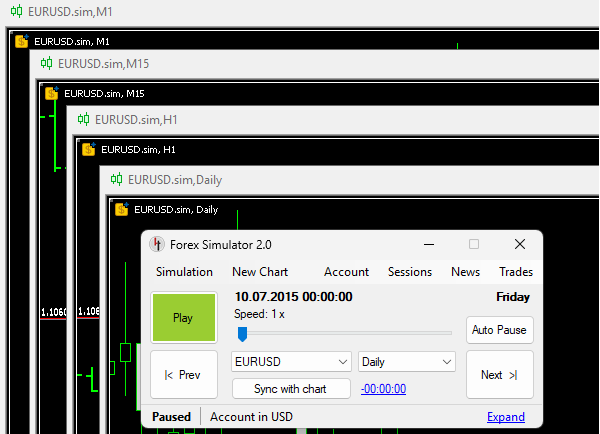
You can open several charts at once and follow price action on several timeframes.
All charts are synchronized and updated tick-by-tick.
You can also tell the program to pause the simulation automatically on certain events:
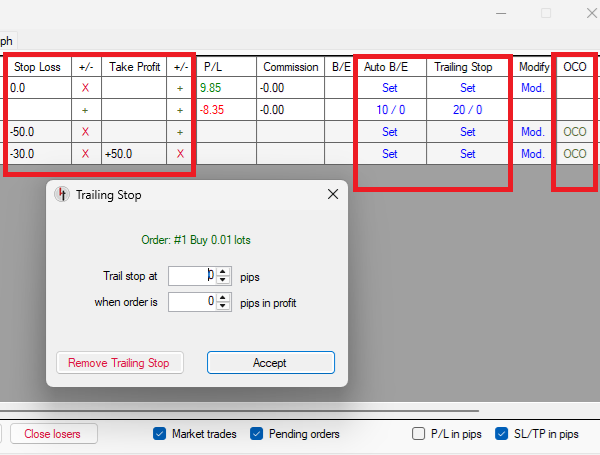
Following automatic rules can be applied to any trade:
Moreover, you can use order templates to work faster and avoid repeating the same steps. A template can be used to save your trade management rules and load them at any time.



Elias wasn’t a grandmaster. He knew the basics—1.e4 and 1.d4, the odd Sicilian at Sunday club—but the book pulsed oddly, as if the printed pages remembered moves they had seen. Volume B covered the semi-open games and many Sicilian, Caro-Kann, and French variations. The diagrams, dense with theory, felt less like instruction and more like a map to hidden crossroads.
Her story filled a slow hour with warmth and regret. She had used chess to keep memory from fracturing, to teach geography when maps had been confiscated, to schedule meetings in plain sight. The entries were love letters in algebraic form. Elias realized the book’s diagrams—so clinical on their surface—had been repurposed as human scaffolding.
Elias, moved, began to catalog the annotations. He photographed pages and posted careful transcriptions on a public board at the shop. Players, historians, and relatives visited, filling gaps. A retired radio operator identified the shorthand as a crude one-time pad: moves mapped to letters. Together they decoded a fragment: “Safe. Tomorrow. Bridge.” They pieced that to a meeting that had once occurred at dawn under a span of stone, where a group traded poems and contraband seeds.
Years later, a young grandmaster preparing for a match stood at the display and noticed a marginal note beside a Sveshnikov line—a terse diagram and the word “Remember.” He smiled, not for the secret messages, but because in the end it was chess’s intrinsic truth: we learn from move to move, annotate our lives with small, precise marks, and leave behind pages that other hands will press, read, and keep moving forward. encyclopedia of chess openings volume b pdf
The book’s most haunted page was a variation of the French Defense. A line written in hurried script read: “When he plays 14…Qd7, do not castle.” Below it, a short paragraph: “He will wait until you trust him.” Elias traced the letters and felt, oddly, that the phrase referred to more than rooks and kings.
He took it home and read about the Najdorf, the Scheveningen, the Kan, and lines named for generational ghosts—Taimanov, Sveshnikov—each entry a compact chronicle: move orders, critical continuations, annotated assessments. In the margins, someone had scribbled dates and tiny match scores: “Lisbon 1958, 12…Nc6! — reply?” A note in German: “Verloren—zug 23” (Lost—move 23). A name beneath, half-erased: Marta?
When the shop closed for renovation, Elias donated Volume B to a small museum of local memory, where it sat behind glass with a plaque describing both its official identity and its secret life. People came to see the printed theory, but lingered over the faded pencil loops that bridged continents and eras. Chess enthusiasts studied the openings and the marginal novelties; poets read the scraps of decoded correspondence and found, in the economy of notation, a kind of restraint that made every small word heavier. Elias wasn’t a grandmaster
On a rainy afternoon in 1994, Elias Martell—an unassuming bookseller with a crooked smile—found a battered box tucked behind crates of remaindered atlases in the basement of his shop. Inside, wrapped in brittle tissue, lay a slim hardbound book stamped, in faded gold, “Encyclopaedia of Chess Openings — Volume B.” Its spine creaked like an old ship as Elias opened it and saw the faint pencil annotations in the margins—miniatures of positions, arrival times, and single words in four languages.
Volume B remained on its shelf, no longer merely a reference but a testament that even the most technical manuals could hold the soft architecture of life—how an opening named for a city could shelter a sentence, how a pawn push could be a promise. The book taught its readers, across decades, that openings are beginnings not only of games, but of stories waiting to be played.
The book’s marginalia, insignificant on their own, began to form a lattice of stories: a displaced coach teaching the Najdorf to hungry students in a cellar; a woman named Marta who annotated lines to help a lover remember moves after a head wound; a player named Kovalenko who used chess orders to schedule clandestine radio broadcasts after curfew. Volume B, originally meant to catalogue opening theory, became a ledger of small resistances—moves chosen not only to win games but to defy circumstance. The diagrams, dense with theory, felt less like
Curiosity made the book contagious. A mapmaker loved the clarity of its diagrams. A widow who’d once watched her husband play studied the Sorokaev variations and found, in the symmetry of pieces, a kind of solace. The local librarian, an amateur historian, noticed references to towns that didn’t match any modern atlas. She found one pencil note that read “Kovalenko, Lviv ’49” and, following that thread, discovered an archival program listing a refugee tournament where displaced players tested new ideas to keep minds sharp in camps.
As the decoded phrases accumulated, an organized pattern emerged: chess openings used as a mnemonic network—booked moves as calendar codes, tactical motifs as distress signals, trap lines indicating safe houses. Volume B had become an atlas of lives lived between moves. The names in the margins were not only chess players; they were couriers, caretakers, lovers, exiles.
On a gray morning, an elderly woman entered the shop with hands like folded maps. She stopped in front of Elias and, without preamble, said, “Marta.” Her eyes found the book as if it had been a compass all her life. She explained in halting words that during the winter of 1949 she’d annotated a copy of Volume B to teach a man with a head injury to remember names and routes. The pawn structures were anchors; the opening novelties were songs. She had given the book to a student who fled with it, and she had never seen it again. The penciled notes were her handwriting.
One rainy evening, Elias received a letter without a return address. Inside, on paper yellowed with age, an excerpt of a correspondence: “Dear Marta, the 12…Nc6 novelty will keep them busy, but the dangerous truth is in the queenside. When the rook takes, remember the pawn you left behind.” It ended with a single line—“If found, return to K.” The initial matched the half-erased name Elias had seen.
Word of the find spread slowly. Among Elias’s customers was a retired professor of linguistics, Dr. Ana Ruiz, who claimed the marginalia contained shorthand from a Cold War correspondence course—chess as clandestine pedagogy, opening lines used to encode phrases. Another patron, a young tournament player named Marco, took the book home and began to work through a neglected Sveshnikov line. He found an idea in the annotations—a timely pawn sacrifice—and used it to win the local club championship a month later. He scribbled “Thanks, Marta?” in the margin and slipped the book back on the shelf.